I’m often asked what are some of my favorite exercises for the core? First, what is the core? The core is the group of muscles that work together to stabilize the low back. Picture below is the intrinsic stabilization subsystem (ISS) top, as well as a closer look at the anatomy (bottom).
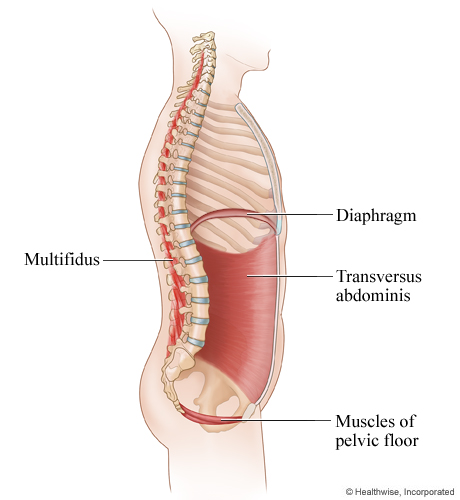

So what are these 3 exercises? Well, I’m not the biggest fan of the crunch due to the increased pressure it causes on the disc, that can lead to low back pain. I feel that for the general population that sits 10+ hours of the day it’s not a good idea. Instead I suggest these 3 exercises to get you started: dead bug, planks, and birddogs. I like these exercises because they are easy to scale depending upon your skill level. One aspect that needs to be carried over is proper breathing strategy. If you need a refresher on breathing, check out my recent blog “Bring it to the Breath” or check the video out below. Based on the principles of Dynamic Neuromuscular Stability (DNS), we must begin with the breath to properly aid in the stability of the core, without proper breathing and stabilization movement will be suboptimal, leading to an increased risk of injuries. If you are unable to breath well in the position it will be best to work on this before progressing to these other exercises.
The dead bug is an excellent continuation from the breathing. It works on forcing yourself to stabilize your core while moving an arm/leg/both. We get the added benefit of having the extra proprioception from the contact the low back has with the ground. This is also great way to train the arm to work in an open chain. Remember to keep the position from breathing without compromising the breathing while moving your limbs.
The plank is another excellent option to work the core safely. We will show a good progression from beginner to advanced in the front plank and side plank. As before, remember to breath and to not compromise on form. Keep a stiff, rigid, straight spine during the hold.
The final exercise rounding out this series is the bird dog. This has an advantage of training the hip and shoulder in a closed chain activity working on stability while also working the hip and shoulder in an open chain fashion. Make sure to maintain a neutral spine not over extending the low back and avoid really shifting side to side while performing.
Add these to your next day of core. Remember it’s better to do fewer reps or less time more frequently to not compromise form than to do more reps for more time with cruddy form.
DISCLAIMER: THIS WEBSITE DOES NOT PROVIDE MEDICAL ADVICE
The information, including but not limited to, text, graphics, images and other material contained on this website are for informational purposes only. The purpose of this website is to promote broad consumer understanding and knowledge of various health topics. It is not intended to be a substitute for professional medical advice, diagnosis or treatment. Always seek the advice of your physician or other qualified health care provider with any questions you may have regarding a medical condition or treatment and before undertaking a new health care regimen, and never disregard professional medical advice or delay in seeking it because of something you have read on this website.
 Movement Ready